From Waiting for Rain to Farming with Confidence
For many years, Biregeya Jean Paul planned his farming around one thing he could never control: the rain.
If the rains came late, his crops suffered. If drought lasted longer than expected, he harvested less. Like thousands of smallholder farmers across Rwanda, especially in the country’s dry Eastern Province, he depended entirely on the weather to feed his family and earn a living.
Today, that has changed.
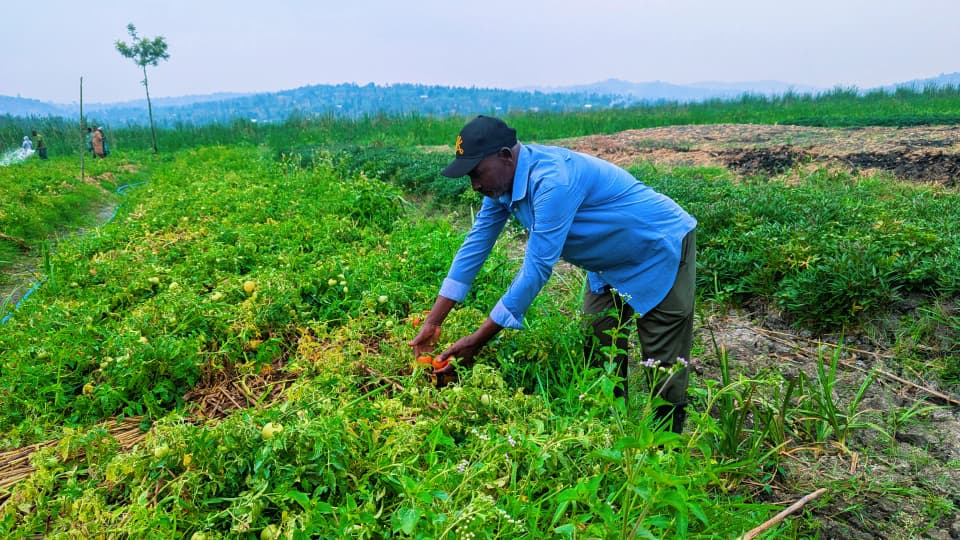
Jean Paul, from Mimuri Sector in Nyagatare District, no longer worries about whether the rainy season will arrive on time. With a small irrigation pump received through the Sustainable Agricultural Intensification and Food Security Project (SAIP II), he can grow crops without depending on the rainy season. He can plant at any time of the year, harvest more, earn more money and even help neighbouring farmers irrigate their fields.
A Small Irrigation Pump, A Big Difference From six tonnes to eight
For Jean Paul, life before irrigation was difficult.
“I used to irrigate my crops with a watering can,It was hard work because I had to carry water every day. Our area receives a lot of sunshine, and the soil dries quickly. Sometimes I worked the whole day but still could not give enough water to my crops.” He recalls.
Because he relied on rainfall and manual watering, his harvests remained low despite working hard.
“Before I got this irrigation equipment, I harvested about six tonnes of maize. After I started using the pump, my harvest increased to around eight tonnes. That difference has changed my life.” He said
The improvement did not stop with maize.
Tomato farming, one of his main sources of income, became much more profitable.
“Before irrigation, I earned about RWF 1.5 million from tomatoes. Today I can earn around RWF 3 million because water is no longer my biggest challenge. The crops grow well even during dry periods,” he said.
The higher income has transformed his family’s living conditions.
“From the money I earned after getting irrigation, I bought a cow worth about one million francs. Later I bought a house worth around RWF 3.5 million. Everything came because farming became more productive.”
His irrigation pump has also become a business.
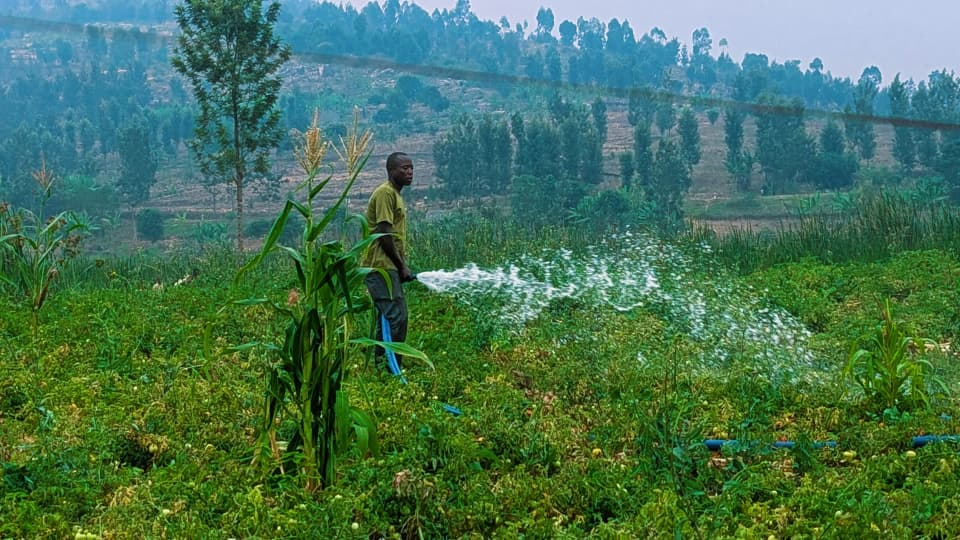
Neighbouring farmers regularly hire him to irrigate their fields whenever they face water shortages.
“People call me when they need help. I take my pump to their farms, irrigate their crops and they pay me. It gives me extra income even when I am not harvesting my own crops.” He said
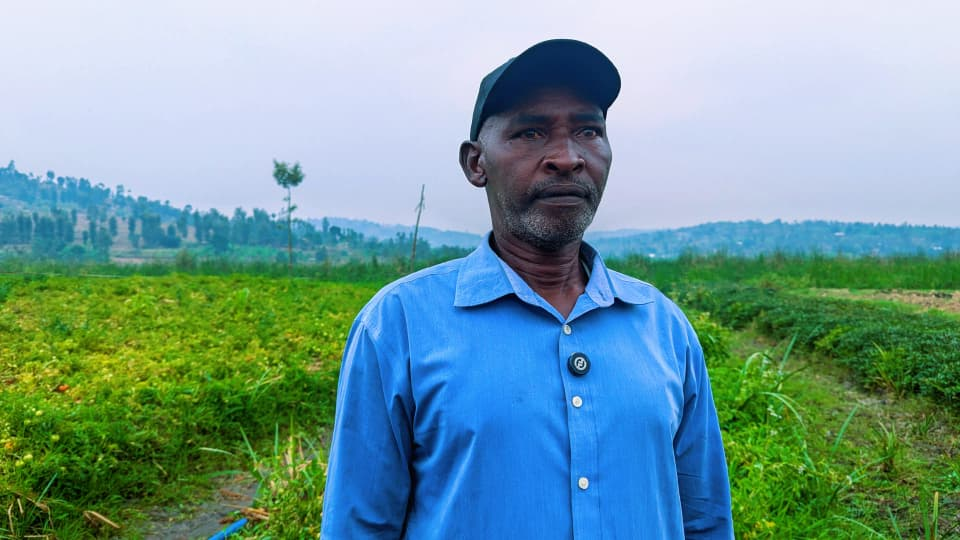
Jean Paul believes many farmers who still depend on rainfall are not failing because they lack knowledge or commitment.
“The people you see who are not farming during the dry season are not lazy. Many simply do not have irrigation equipment. If they receive the same opportunity I received, they can also improve their lives. That is why I encourage farmers to register whenever this programme is announced.”
Government Support Helping Farmers Adapt to Climate Change
His experience is one example of what Rwanda hopes to achieve through increased investment in irrigation as climate change continues to make rainfall less predictable.
The Sustainable Agricultural Intensification and Food Security Project (SAIP II) is implemented by the Rwanda Agriculture and Animal Resources Development Board (RAB) through its Single Project Implementation Unit (SPIU), with support from the World Bank and other development partners. The project currently operates in 20 districts across Rwanda, helping smallholder farmers access Small-Scale Irrigation Technologies (SSIT) that enable them to grow crops without relying entirely on rainfall. By improving access to irrigation, the project is increasing agricultural productivity, raising household incomes, improving access to markets, strengthening food security and helping farmers become more resilient to climate change and unpredictable weather.
SAIP II is helping farmers access Small-Scale Irrigation Technologies (SSIT) for land ranging from 0.5 to 10 hectares. Depending on location, land size and farmers’ needs, the programme supports diesel-powered pumps as well as solar-powered irrigation systems.

According to Innocent Nzabamwita, Irrigation Engineer Specialist at RAB-SPIU, the Government has introduced subsidies to remove one of the biggest barriers preventing farmers from investing in irrigation equipment.
“Government subsidies for small-scale irrigation equipment are available to farmers cultivating between 0.5 and 10 hectares. The farmer contributes 50 percent of the cost of the equipment, while the Government pays the remaining 50 percent,” he explains.
He says farmers who choose environmentally friendly solar-powered irrigation systems receive even greater support.
“For farmers cultivating between five and ten hectares who install solar-powered irrigation systems, the farmer contributes only 25 percent while the Government subsidizes the remaining 75 percent.”
Nzabamwita says the programme has received strong demand, especially in Eastern Province where long dry seasons make irrigation essential for crop production.
“We continue to see more farmers applying because they can clearly see the benefits from those who already received irrigation equipment. Farmers are increasing production, earning more income and becoming less dependent on rainfall.”
The programme is also encouraging more farmer groups and cooperatives to apply so that more families can benefit from a single irrigation investment. This approach allows farmers with smaller plots to work together, reduce costs and improve access to markets.
Building Skills for Sustainable Irrigation
Beyond distributing irrigation equipment, SAIP II is strengthening farmers’ ability to manage irrigation systems for the long term.
Project achievements show that more than 2,100 farmers have been trained in water management, irrigation system operation, maintenance, administration and financial management. Across irrigation schemes, 81.5 percent of farmers are now paying water service fees, helping ensure that irrigation systems remain operational and well maintained.
The project has also strengthened Water User Associations by identifying and organizing new groups to manage irrigation schemes, while follow-up support has helped farmers carry out routine maintenance, repair pipelines, clear canals and improve water distribution.
Environmental protection is another important part of the programme. Buffer zones have been established around irrigation infrastructure using bamboo, grasses and different tree species to reduce soil erosion and protect water sources. These efforts have reduced sediment entering irrigation canals by 98 percent while improving biodiversity and strengthening climate resilience.
Expanding Irrigation Across Rwanda
The project has also made significant progress in expanding small-scale irrigation across the country.
During the first phase, SAIP supported irrigation on more than 1,367 hectares across nine districts. Under SAIP II, the programme expanded to 20 districts and has already facilitated irrigation on more than 1,000 hectares, surpassing its original target. Together, the two phases have benefited 3,369 farmers, including 1,916 men and 1,453 women.
Project data also show that 2,872.7 hectares were identified as suitable for small-scale irrigation, while 1,779 hectares were approved for implementation. By June 2025, SAIP II had supported irrigation on 1,077.6 hectares using both solar-powered and diesel-powered systems, exceeding the original target of 1,000 hectares. Of this area, 591.4 hectares were irrigated using solar-powered systems and 486.2 hectares using diesel-powered pumps. A total of 1,029 farmers, including 594 men and 435 women, directly benefited from these investments.
Supporting Rwanda’s National Vision
These achievements support Rwanda’s national vision of building a modern, productive and climate-resilient agricultural sector.
Under the National Strategy for Transformation (NST2), the Government aims to increase annual agricultural growth to more than six percent while expanding irrigated agricultural land from about 74,375 hectares to 132,171 hectares by 2029. Expanding irrigation is seen as one of the country’s most important investments for improving food security, increasing agricultural exports and protecting farmers from the growing effects of climate change.